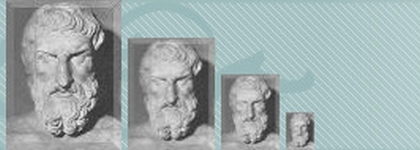
Cyrenaic philosophers and hedonism

It was the philosophers, Aristippus the Older and Aristippus the Younger, who lived in Cyrenaica, who first suggested that hedonism was the right waty to conduct a good life. That basic idea, modified of course, was adopted by Epicurus, and later was misinterpreted by the early Christians to mean a life of total self-indulgence, eating, and drinking, careless of the duties of life. Basically, the latter believed we are all sinners and should be endlessly tormented by the “fact” and cover ourselves in sackcloth and ashes. How this strange point of view gained traction is a mystery and a misery.

So maybe it’s got something to do with my Anglican upbringing, but I feel most uncomfortable about too literal an interpretation of “hedonism”, which has these unfortunate connotations of self-indulgence. It denotes selfishness and excludes any idea of doing constructive things for other people. I prefer the idea of pursuing what gives you pleasure. One can pursue a life of pleasure, fueled with moderate amounts of wine and good living, by doing a job you love, by involvement in the arts, by devoting yourself lovingly to another person, or helping the sick and poor. And a hundred other things, since we are all different, with different outlooks and interests (itself a wonderful aspect of the human condition).

Giving of yourself can be a joy, in particular. Philosophers seldom say so. Gorging yourself with food, drink and cigars, on the other hand, is not only unattractive and vulgar, but is elitist, since only rich, spoiled people have the means to crudely self-indulge.  Epicurus, as we all know, was modest in his daily living and an advocate of the restrained Mediterranean diet. He also ran a “flat” organisation, and was no empire building CEO. Good guy, which is why I like him.

So while we can be grateful to the Cyrenaic philosophers for rejecting a monastic life of woe, sackcloth and ashes, eating only porridge and lashing yourself with leather-thonged whips, I think (unless I missed something) that they should have been more expansive in their definition of hedonism. Let us enjoy the short lives afforded us, but do so in moderation, generosity, and with a sense of humour.

Who’s using whom?

As internet companies have challenged existing business models, from taxi services to hotels, they have rubbed up against existing regulations. They have increasingly lobbied to change them, just like their corporate brethren, but are doing so by recruiting unaware users to promote their cause, using apparently harmless, “one-click-and-you’re-done” methods.

When India’s telecoms regulator sought public consultation on services that offer limited access to internet sites via phones, one such service, called Free Basics, owned by Facebook, invited millions of its users to send boilerplate emails of support, deluging the unamused regulator. 

Uber, for example, last year defeated a proposed cap on the number of its vehicles in New York City. One of its tactics was to roll out a new mode on its app named “De Blasio” – after the city mayor championing the cap. The mode made all of Uber’s cars disappear from the map and directed users to a petition. And home-stay giant Airbnb is organising its US users into “guilds” to fight proposed regulations on short-term rentals around the country.

Internet services have spent vast sums learning how to direct their users’ activity, something that can be exercised with little transparency and without the user being fully briefed on what he or she is being asked to do. (Based upon an article entitled “Customer or lobbyist?” in the New Scientist).

Beware of being part of anti-consumer, untransparent campaigns to increase the profits of these tech companies  – unless they are very clearly in your best interest. They are tantamount to at least an invasion of privacy; others would say they are are basically dishonest. In any event, they are un-Epicurean.

French businessmen dress better – but so what?

“I first noticed how well French business leaders dress in 2013”, when Publicis chief Maurice Lévy unveiled his doomed $35bn merger plan with the US group Omnicom, says Adam Thomson. Lévy strode out in a black suit, crisp white shirt and black tie: “it was understated but elegant and brimming with confidence”. His opposite number’s blue shirt and gold tie came a distant second. The Lévy black-white-black combo is a classic in France. Indeed, the “flamboyant” London code of pink and striped shirts “could easily derail a promising career” in Paris. And in France, clothes fit; while if you remove an Englishman’s jacket you will probably “discover a spinnaker billowing under his arms”.

What explains this style gap? I blame school uniforms, which English children wear and the French do not. Choosing what to wear makes French children more aware of clothes and fit; uniforms bought by value-conscious parents, by contrast, are either too large, or too small. The lesson, if you’re heading for Paris, is to play it safe: “rein in the colours, and above all, wear a suit that fits”. (Adam Thomson, Financial Times)

I have no doubt that feeling elegant and well dressed gives you confidence, but no amount of money and tailoring can substitute for brains, ability, shrewdness and understanding of human nature. Over the years the French seem to have consistently underestimated the Anglo- Saxons, which is why, relatively speaking, the latter have more thriving economies than the French. Enough with style! Bring on substance!

Moreover,the writer is, in my opinion, totally wrong-headed about school uniforms, which avoid the horrible business of competitive dressing in schools and its attendant bullying and teasing of less well-@off children. Moreover, they denote ‘egalite’, a concept introduced during the French revolution and apparently abandoned thereafter. Epicurus would have approved of the uniform. It assists peace of mind.

Remembering apartheid

Back home from Africa……

My wife asked for some brown bread at lunch in a restaurant in Namibia, a country ruled by South Africa until 1990. Our guide explained to her that until 1990 no white person would ever ask for brown bread, which had grit in it and damaged teeth.  They ate only white bread of much better quality.  Black servants doing the shopping for their employers at a bakery needed written authorisation to buy white bread for the household. Brown was only for coloureds, white for whites.

Such was the crass futilty and unfairness of apartheid.  In Namibia brown bread is now of excellent quality, as good or better than in Washington and London, but it seemed significant that the waitress never did bring my wife her brown bread.  Maybe she forgot; maybe old habits die hard.

Epicurus, who welcomed women, slaves and, very likely, other picked-upon people, would have been very indignant at the divisive and totally unnecessary indignity of the breads.

Meanwhile, I am happy to report that we found Namibia, with only 2 million people, to be very well organised, very friendly, the tourist guides experts at their jobs, and the country complete with every modern amenity – probably not what the Boer masters would have expected when they gave up control.

Learning mathematics

The teaching of mathematics in the US and U.K is alleged to be in a huge crisis. So much so that the British Chancellor of the Exchequer announced that he wanted compulsory maths taught in State schools up to the age of 18. Maths is the subject that the illuminati use to judge the excellence of teaching, and they have pronounced the US and UK particularly hopeless.

And yet one has to look at not just how a subject is taught, but what is being taught.  A YouGov survey in England found that about a third of those surveyed had no idea how to calculate a mode, a median or a “line of best fit”, or the area of a circle.  Well, this reader knows (or thinks he knows) what a median is and how to calculate the area of a circle.  But he’s never heard of a mode (except in music) and apparently “line of best fit” has something to do with regression analysis, but he has no idea what it is.

I am in my third quarter of a century and have never needed any of the above, never learned statistics and never needed them.  I taught myself book-keeping and how you produce profit and loss figures.  And that, after the invention of the pocket calculator, was all I have needed, except for being able to add, subtract and divide in my head.

So why do we beat ourselves up comparing ourselves with the (dire) learn-by-rote Chinese system? If our system is so bad why, when we visited MIT in Cambridge, MA did we notice that practically every student we encountered was Asian?  Somebody clearly has a high opinion of what is taught there. Why do rich Chinese send their teenage children to British boarding schools if maths is so badly taught and is the be-all-and-end-all?

What we should be focusing on is comprehension of a passage in English, the ability to explain its meaning lucidly and, in turn, to speak and write using correct grammar and with a wide vocabulary. Then we can communicate. Kids should know the basics of mathematics but be very well versed in their language. There are other things they should also know, but reading, writing, comprehension and persuasive language has to be top, not mathematics.