The Silent Generation

One hears a lot about Baby Boomers, Generation X etc, These classifications are designed by journalists to allow them to make sweeping and outrageous generalisations about huge groups of people with little in common, except that they were born between certain dates.

I never thought about this much, but, late in the day I discover that I am a member of the “Silent Generation”. You have probably never heard of the Silent generation. That’s because it is largely silent. My wife and I are members. We were born three and a half thousand miles apart, but we share very similar upbringings, based on the following good principles:

– children should be seen and not heard
– respect for older people
– the words “please” and “thank you” are important.
– always write thank-you letters for treats or presents.
– eat what’s on your plate.
– “When I say go to your room, you go to your room”.
– bad school grades are not acceptable.
– you do not interrupt adults.
– make your bed and help clean up after dinner.

I maintain that being brought up being used to discipline, self-discipline, politeness and thinking of other people is a good basis for a cooperative and civilised society. But I now suspect that this might be regarded as old-fashioned.

Pandering to the fat cats?

A recording was leaked to the UK Press recently. It was a conference call between Chancellor of the Exchequer, Philip Hammond, and bosses from Amazon, Siemens, Tesco and other multinationals, in which they all discuss how to block a no-deal Brexit. It’s a key concern for such companies, and you can see why. The giants do well out of the EU system. Rather than having to invest in machinery and training, they can rely on a steady flow of imported cheap labour. They can afford lobbyists to ensure the regulations work for them, not least by serving as a barrier to entry for smaller competitors. So naturally they want to preserve the status quo.

“But “Brexit was a vote to change the system” and was much favoured by small companies, which were more likely to support it. Yet as the Hammond tape shows, ministers only listen to the big companies – the small ones don’t get a look in. As the party of business, the Tories ought to be on the side of the “small guy” as well. “Colluding with corporates about how best to frustrate a referendum result isn’t a good look.” (Fraser Nelson Daily Telegraph reported in The Week, 26 January 2019)

For non-Brits this is a good example of the sly misinformation put out by the right wing media. Of course big companies want to avoid Britain crashing out of the EU. It would be very damaging and disruptive to businesses, large and small, cascading down, with trade disrupted and great uncertainty.

The amateurish manner in which Brexit was presented to the British public might have persuaded some business owners that it would be advantageous, but now they have learned the real, hard facts and have seen the dismal economic forecasts, it defies logic and common sense for small businessmen to back Brexit at all. The only reason they might is personal feelings about immigrants. I have little regard for the Chancellor, but what is he supposed to do, phone thousands of small companies, one at a time?

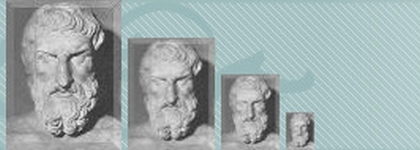
Epicurus and the universe

Epicurus believed that there were twelve principles of nature, provable through firm evidence and true reasoning, using our five senses, our faculty of perceiving “anticipations,” and our “feelings” of pleasure and pain. He believed in conclusions supported by clear and convincing evidence. No evidence, he said, is ever to be disregarded as worthless. Real evidence is essential. Error occurs only in the mind, and where evidence about a matter is insufficient to give rise to a firm opinion, we must wait before labeling any opinion about the matter true or false.

Epicurus taught that we have no need to rely on any gods, priests, or supernatural claims for our understanding of Nature. What our faculties suggest to us is “true”. Only if we use them properly we can be confident in our conclusions. And we can only use our faculties properly if we understand the process by which they operate.

Epicurus concluded that the following twelve aspects of nature are crucial to understanding how both Nature, and our faculties, operate:

1. Matter is uncreatable.
2. Matter is indestructible.
3. The universe consists of solid bodies and void.
4. Solid bodies are either compounds or simple.
5. The multitude of atoms is infinite.
6. The void, or Space, is infinite in extent.
7. Atoms are always in motion.
8. The speed of atomic motion is uniform.
9. Motion is linear in space, vibratory in compounds.
10. Atoms are capable of swerving slightly at any point in space or time.
11. Atoms are characterized by three qualities: weight, shape and size.
12. The number of the different shapes is not infinite, merely innumerable.

Yes, today we know so much more, use a plethora of new names, techniques and instruments. And atoms are indeed divisible. But the reader can observe that the basics of the modern scientific method are there, and that, using “true reasoning” (the ancient Greeks did not even have a telescope) Epicurus was right that, at some fundamental level, the physical universe is composed of particles, and that any phenomenum that is observable to the senses exists as part of our own universe and is neither created by, nor is subject to, any supernatural forces.

The method by which these elemental observations were established can be found in Epicurus’ “Letter to Herodotus” and in Lucretius’ De Rerum Natura.

The above list of twelve elementals was reconstructed by Norman DeWitt in his book Epicurus and His Philosophy. A similar list has also been prepared by Professor Diskin Clay in his work Paradosis and Survival.
(Edited version of an article on New Epicurean.com, with thanks)
No.2: Is the Brexit referendum actually constitutional?

For the record: in 1689 the principle of the sovereignty of parliament was finally established, with no ifs and buts, and role of the new king and queen, William and Mary and their successors, has been to sign off on any legislation passed by Parliament, whether they liked it or not. Thus it has been ever since – until Harold Wilson organised a non-binding, advisory-only (note!) referendum. There have been other referendums since, but only one, in 2011, was specifically binding on the government. The Brexit referendum carried no mention of being binding. As one constitutional lawyer commented, “Brexit could end up being a lot more damaging to parliamentary sovereignty and the domestic constitutional order than the external influences of EU law may ever have been”. (R. Ekins, ‘The Legitimacy of the Brexit Referendum’, UK Constitutional Law Association, 29 June 2018)

A major point of the referendum was to restore British parliamentary sovereignty, but it simply doesn’t! It hands over major decisions to the people, 95% of whom do not have a clue about the complexities of modern government, or the the workings of the EU (apparently Leave MPs don’t, either!). Westminster faced the Catch 22 situation where it couldn’t politically ignore the results of a referendum supposedly held to restore its sovereignty, despite the fact that the majority of its members disapprove of the outcome. In addition, the UK government robbed Parliament of its role in the actual Brexit process.

Why has there been so little debate on this subject? Do MPs understand the point? And why is this an Epicurean question? Because it will cause great loss of peace of mind in the future. Generations to come regret it as more stupid questions are asked of a poorly informed electorate