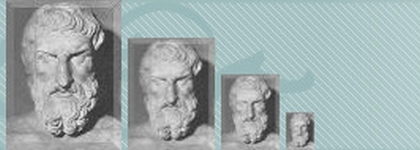
A pleasant life can only be lived if we train our minds daily to relish and enjoy what is there, however prosaic it might be. An Epicurean must discover the pleasures of laughter, walking, eating simple food, the pleasure of friends, instead to mindlessly going through the motions. Let us live while we are alive! (Epicurus)
Genes and environment
Studies at the Minnesota Center for Twin and Family Research suggest that many of our traits are more than 50% inherited, including obedience to authority, vulnerability to stress and risk-seeking. Even in things like religion and politics our choices are much more determined by our genes than we think.
However, in recent years faith in the explanatory power of genes has waned. Today, few scientists believe there is a simple “gene for everything”. Almost all inherited features or traits are products of complex interactions of numerous genes and the environment. Take IQ, which has a hereditabilty of 70% on average. In the case of students at Harvard, who come from similar, educated, middle class families and have similar upbringings, the environmental upbringing factor is over 90%, the balance being down to genes. Any change in the environment has a much greater effect on IQ than genes. If you want to find out if someone believes in god it is more useful to know that they have lived all their lives in Texas than to know the ins and outs of their genes. (The Week)
In my family the males get prostrate cancer, on the dot, in the first three months of their 60th year. This has been so going back as far as I have records to prove it. It’s like a clock. Scary, but at least you can nowadays fix it. However, I have a problem believing that obedience to authority and belief in religion are more than 50% inherited. Or if they are, education and an ability to think for yourself can surely overide it? What do you think?
Has Poetry hit the buffers at the end of the trainline?
Most modern poetry is unappealing to readers and listeners alike because it is so often obscure and difficult to follow. It is written in free verse (or prose-poetry as it should be more accurately called) — a hybrid form of writing which is neither prose nor poetry. By turning their backs on the traditional skills of poetry as old-fashioned and restrictive, the prose-poets like to boast that they are freeing themselves from the shackles of ‘formalism’. The result is the rambling complexity that characterises so much modern poetry. As Robert Frost famously once said: ‘Free verse is like playing tennis without a net.’. Too much of it is incomprehensible, when it should clearly communicate.
Why should prose-poets, or any poet for that matter, think that they are exempt from learning and practising a craft that has resulted in centuries of literary heritage? By all means adapt the diction or prosody to suit the temper of the time; but throwing the baby out with the bath water is wilful and self-defeating. (part of an article by Paul Gittins in Oxford Today, May 2015)
The Rhyme. (my comment on modern poetry)
Poets now despise the rhyme,
Or that’s the affectation.
But nonsense is as nonsense does
And what is worse than bad blank verse? –
Gibberish strung upon a line,
Conforming to the fashion?
The wish being father to the thought,
It’s promptly
Found
To be
Profound.
Rhymes outdated? That’s just rot!
Some can rhyme, and some can not.
It’s content, not the form, that counts,
And mastery of meaning.
A certain discipline of mind
Is requisite when using rhyme.
So don’t reject the tools at hand,
Misused as they may be.
The means can justify the end.
My point is penned.
Enough!
The End!
by the author of this blog
Marriage and the ten year itch
We traditionally talk about the ‘seven-year itch’, but according to a new study, it’s at ten years that relationships start to really suffer. Researchers gathered 2,000 women who were born in the 1950s and 1960s, and had married in their mid 20s, and quizzed them at intervals over 35 years. Participants were asked, for instance, how happy they were, how often they and their husband laughed together, and also what they argued about. The results suggest that in almost all cases, happiness starts to decline almost as soon as the honeymoon is over. Problems reach a peak at ten years to 15 years, possibly owing to the responsibilities of family life. But if couples soldier on for a few more years (by which time children are more independent), the conflict levels start to drop off, and by 35 years, some report being as happy, or even happier than they were at the beginning. (from The Independent).
I think a key to a happy marriage is respect: love finds it hard to survive if there is no mutual respect for the judgment and common sense of your spouse. Secondly, you both have to really want to have and enjoy children; the teenage years can be a particular trial. Thirdly, you have to have interests, attitudes and activities in common. A passion for shopping is better than no passion at all! This may presuppose similarities in education and background. We all change in time, given stress and work, but an ability to continue learning and to adapt makes a big difference. Many couples drift apart because one partner grows as an individual, while the other does not. Then you have to have, and share, a similar sense of humour. Lastly, there has to be equal effort (husbands who pull their weight at home!). In other words, it is not about the length of marriage; it’s about true compatibility and a deep level of friendship. The cleverest person can trip up on looks and physical attraction, which are only part of the equation.
A explanation of this blog: what is its point?
All comments on this blog are made in the context of the Epicurean way of life, that is:
– Everyone should aim for a pleasant life, full of joy and happiness. This has nothing to do with self-interest, greed and gluttony; on the contrary, Epicureans believe in having only what is necessary for health, laughter, friendship and mutual care of others. Moderation is the watchword.
– Where the blog comments upon politics, violence, greed, bullying, and social affairs, it is to modestly try to remind readers that Epicureans are peaceful, tolerant citizens, who think about others, help neighbors and friends, hate warfare, deplore autocracy and the decline of democracy.
– Because Epicurus accepted women and slaves in his Garden, and is believed to have been generous to the poor and sick, Epicureans lean towards a point of view that says that we all inhabit this crowded planet and should endeavor to compromise, empathize and generally try to get along with everyone. However, they also don’t want to waste their lives making overtures to cruel, selfish and hostile people on the make, either.
– Epicureans are natural followers of science, who do not believe in super-naturalism, miracles or afterlives. But – they respect those who believe in these things because they realise that they contribute to pleasant lives and happiness for those who have a spiritual need for them.
– Courtesy and good manners were developed to make life more pleasant. They are not exclusive to educated or middle class people, but come maturally to those who think of, and value, other human beings and desire good relationships with them.
The above doesn’t describe the complete philosophy of Epicurus, which would be too long to summarize. But if you like the drift hang on in here and take part. You are welcome.